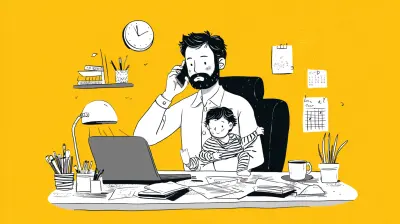
Balancing Individual Attention in Multi-Child Families
24 August 2026
There is a moment every parent of more than one child knows well. You are sitting on the floor, building a block tower with your youngest, when your oldest appears with a drawing they have been working on for an hour. They hold it out, eyes hopeful, and you feel the familiar tug. You want to look. You want to praise. But the tower is wobbling, and the baby is about to grab a block that is definitely not safe to chew.
This is not a rare problem. It is the daily rhythm of life in a multi-child household. The guilt that follows, the feeling that someone is always getting less than they need, is just as common. But here is the truth that often gets lost in the noise: individual attention is not about equal minutes. It is about the quality of connection, the predictability of availability, and the small, consistent ways you show each child that they are seen as a person, not just as part of a group.

Why the "Equal Time" Myth Fails
Many parents fall into the trap of trying to split time down the middle. Fifteen minutes with the toddler, fifteen minutes with the school-age kid, then a timer goes off and everyone switches. It sounds fair. It feels fair. But it rarely works in practice.The problem is that children do not experience time the way adults do. A five-minute conversation with a parent who is fully present can feel far more satisfying than thirty minutes of distracted half-attention. Conversely, a child who is waiting for their turn while watching you laugh with a sibling can feel that wait as an eternity, even if it is only ten minutes.
The equal time approach also ignores the fact that children have different needs at different stages. A newborn needs physical care that is nearly constant. A six-year-old needs help with emotional regulation. A teenager needs someone to listen without judgment, often at odd hours. Trying to give each child the same quantity of time is like trying to feed a newborn and a teenager the same portion size. It is not fair. It is just uniform.
What actually works is a shift in mindset. Instead of asking, "Did I give each child the same amount of time today?" ask, "Did each child have a moment where they felt completely seen?" That is a much more attainable goal, and it is one that respects the reality of family life.

The Power of the "Special Moment" Routine
One of the most effective strategies for balancing attention is to create a predictable, individual ritual with each child. This does not have to be elaborate. It does not have to be expensive. It just has to be consistent and exclusive.For example, one parent might take the oldest child for a walk around the block every Saturday morning while the other parent stays home with the younger kids. It is twenty minutes. The child gets to talk about whatever they want, without interruption from a sibling. The parent gets to see a side of the child that often disappears in the chaos of group dynamics.
The key is that this time is not negotiable. It is on the calendar. It happens even when the house is messy or someone is tired. That consistency sends a powerful message: you matter enough that this time is protected.
For younger children, the ritual can be even simpler. A bedtime routine that includes five minutes of just lying next to them, talking about their day, can be enough. The important thing is that it is one-on-one. No phones. No siblings. No multitasking.
What about families where the parent is a single caregiver? The special moment can still work. It might mean that the older child stays up fifteen minutes later on a specific night, just to have quiet time with you after the younger ones are asleep. It is not ideal, but it is doable. The point is not perfection. The point is intention.

The Art of the "Soft Yes" and the "Hard No"
Children are not always good at asking for what they need. They might interrupt a conversation because they are bored, or they might act out because they feel invisible. A common mistake is to respond to these bids for attention with frustration, which only reinforces the child's feeling that they are a nuisance.Instead, try to distinguish between a request for attention and a demand for immediate gratification. When your child interrupts you while you are talking to a friend, they are not trying to be rude. They are trying to reconnect with you. The "soft yes" is a way to acknowledge that need without dropping everything.
For example, you might say, "I hear you, sweetheart. I am talking to Aunt Sarah right now. Give me two minutes to finish this thought, and then I will be all yours." Then you have to follow through. This teaches the child that their need is valid, but that it can be met with a small delay. It also models patience and respect for others.
The "hard no" is different. It is for situations where you genuinely cannot give attention, such as when you are driving in heavy traffic or handling a crisis. In those moments, be honest and brief. Say, "I cannot talk right now because I need to focus on the road. I will listen to your story as soon as we get home." Then, when you get home, you must remember to ask about the story. If you forget, the child learns that your promises are empty, and they will stop asking.

The Danger of the "Easy Child" Being Overlooked
There is a well-known phenomenon in multi-child families: the easy child gets less attention because they are not demanding it. They play quietly. They do their homework without being asked. They never throw tantrums. And so, slowly, they become invisible.This is one of the most damaging patterns in parenting, and it is often unintentional. The parent is exhausted from managing the child who is struggling, and the easy child seems fine. But "fine" is not the same as "thriving." The easy child still needs to feel seen. They still need to know that their good behavior is noticed and valued, not just taken for granted.
A practical fix is to schedule a check-in with each child, regardless of their behavior. This does not need to be a formal meeting. It can be a casual question at dinner: "What was the best part of your day?" But make sure you ask each child, not just the one who is being loud.
Another approach is to catch the easy child doing something right and comment on it specifically. Instead of saying, "You are such a good kid," say, "I noticed you let your sister pick the movie tonight without complaining. That was really generous of you." Specific praise is more meaningful than general praise, and it shows that you are paying attention.
Handling Sibling Rivalry as a Signal, Not a Problem
When siblings fight, it is often about attention. The child who is hitting is not always angry at the sibling. They are angry that the parent is not looking at them. The child who is crying is not always hurt. They are hurt that the parent seems to care more about the other child.This is a hard truth to accept, because it means that the solution is not always to referee the fight. The solution is to address the underlying need for connection.
One effective technique is to separate the children and give each one a brief, individual moment with you before you address the conflict. For example, you might say, "I need to talk to both of you, but first, Max, come here and tell me what happened from your side." Then listen without interrupting. Then do the same for the other child. This does two things: it gives each child your full attention, and it models how to listen.
Another approach is to use the "family meeting" as a regular forum for airing grievances. This works best with children over the age of five. Once a week, gather everyone and let each person speak for two minutes about something that bothered them or something they appreciated. The rule is that no one interrupts. This teaches children that their voice matters, and it gives the parent a structured way to ensure everyone is heard.
The Role of the Partner and the Extended Family
You cannot do this alone. If you have a partner, you need to work as a team. That means dividing attention strategically, not just dividing chores. For example, one parent might take the older child to soccer practice while the other stays home with the younger ones. Then, on another day, you switch. This gives each child time with each parent, and it prevents one parent from becoming the "fun one" while the other is the "disciplinarian."Grandparents, aunts, uncles, and close family friends can also play a role. A child who has a special bond with a grandparent has an additional source of individual attention that does not come from the parent. This is not a replacement for parental attention, but it is a valuable supplement. Encourage these relationships. Let the grandparent take the child out for ice cream alone. Let the aunt take the older child to a movie while you stay home with the baby. This is not a failure on your part. It is a smart use of your village.
The Problem with "Quality Time" as a Buzzword
"Quality time" has become a cliché, and like many cliches, it has lost its meaning. Some parents interpret it as "intense, planned activities" like a trip to the zoo or a craft project. But quality time does not have to be an event. In fact, the most meaningful moments often happen during mundane activities.Think about it. A child is more likely to open up about a problem at school while you are both washing dishes than when you are sitting across from them at a table, staring at them expectantly. The side-by-side position is less threatening. The shared task provides a natural rhythm that makes conversation easier.
So, do not overthink the "quality" part. Instead, look for opportunities in your existing routine. The car ride to school. The grocery store run. The few minutes while you are brushing their hair. These are all chances for individual attention, even if they are brief.
Common Mistakes That Undermine Your Efforts
Even with the best intentions, parents make mistakes. Here are a few that are worth avoiding.First, do not compare your children to each other. Saying, "Why can't you be more like your sister?" is a guaranteed way to make a child feel unseen. Each child needs to be appreciated for who they are, not for how they measure up to a sibling.
Second, do not use attention as a reward or withdrawal as a punishment. If you only give your child attention when they behave well, they will learn that your love is conditional. If you ignore them when they misbehave, they may escalate the misbehavior just to get a reaction. Attention is a basic need, not a bargaining chip.
Third, do not try to make up for lost time in a big, dramatic way. If you have been distracted for a week, do not suddenly plan a huge outing. The child will see it as a bribe, and it will not undo the feeling of neglect. Instead, return to your small, consistent rituals. The daily walk. The bedtime chat. That is what rebuilds trust.
Fourth, do not forget about yourself. A parent who is running on empty cannot give genuine attention to anyone. It is not selfish to take time for yourself. It is necessary. If you are exhausted, your attention will be shallow and resentful. A rested parent is a more patient parent.
The Long Game: What Children Actually Remember
When your children are grown, they will not remember the exact number of hours you spent with them. They will not remember that you missed a school play because of work. They will remember how you made them feel.Did they feel like they could talk to you without being rushed? Did they feel like you were interested in their lives, even the boring parts? Did they feel like they had a place in the family that was uniquely theirs?
This is the real goal of balancing individual attention. It is not about creating a perfect scorecard. It is about building a relationship that can withstand the inevitable moments of neglect, distraction, and imperfection.
There will be days when you fail. There will be days when the baby screams for an hour and the older child gets a short "not now" that comes out sharper than you intended. That is okay. What matters is what you do the next day. You apologize. You reset. You show up again.
Practical Strategies for Different Age Combinations
The specific challenges of multi-child families depend a lot on the age gap. Here are some tailored approaches.For a family with a newborn and a toddler, the toddler is often the one who feels displaced. The best strategy is to involve the toddler in caring for the baby, but also to carve out time when the baby is asleep or with another adult. Even ten minutes of undivided attention, where the toddler gets to choose the activity, can make a huge difference.
For a family with a preschooler and a school-age child, the older child may resent being asked to "set an example." Do not put that burden on them. Let the younger child look up to them, but do not force the older child to be a mini-parent. Give the older child space to be a kid, and make sure they have time away from the younger sibling.
For a family with a teenager and a younger child, the teenager is often the one who pulls away. They want independence, but they still need to know you are there. The key is to be available without being intrusive. A teenager is more likely to talk to you at 10 PM than at 5 PM. Be flexible with your schedule. And never, ever compare the teenager's behavior to the younger child's. That is a recipe for resentment.
The Bottom Line
Balancing individual attention in a multi-child family is not a problem to be solved. It is a practice to be maintained. You will never reach a point where everyone feels perfectly attended to all the time. That is not the goal. The goal is to create a culture in your family where each child knows they are valued, where they can ask for attention without shame, and where they trust that you will do your best to show up for them.It is hard work. It is often thankless. But the payoff is a family where each child grows up feeling secure in their place, not because they got equal time, but because they got genuine love.
all images in this post were generated using AI tools
Category:
Sibling RelationshipsAuthor:

Max Shaffer
Discussion
rate this article
2 comments
Damon Rocha
Great insights on managing individual attention in families with multiple children. I found the tips on scheduling one-on-one time really practical. It can be a challenge, but prioritizing those moments makes a huge difference. Thanks for sharing strategies that help foster deeper connections among siblings and parents alike.
August 30, 2026 at 3:24 AM
Max Shaffer
Thank you for your thoughtful comment! I'm glad you found the tips helpful. Prioritizing one-on-one time truly can strengthen those important family bonds.
Kira Rios
Chaos is my love language!
August 24, 2026 at 3:02 AM
Max Shaffer
I get that! Finding balance can definitely feel chaotic at times, but it's all about those little moments of connection.